
Your Brain’s Secret Problem-Solving Machine
Think of your brain like the world’s most epic gaming console —
but instead of one giant processor, it’s got millions of mini-processors called cortical columns.
Each cortical column is like a tiny skyscraper full of brain “workers” (neurons) stacked in layers.
They all follow the same rules for taking in info, figuring stuff out, and deciding what to do —
whether you’re playing basketball, trying to remember your homework, or figuring out a fight with a friend.
Mark Aston Smith is a brilliant neuroscientist in England. He explains the process, and we have simplified it for you.
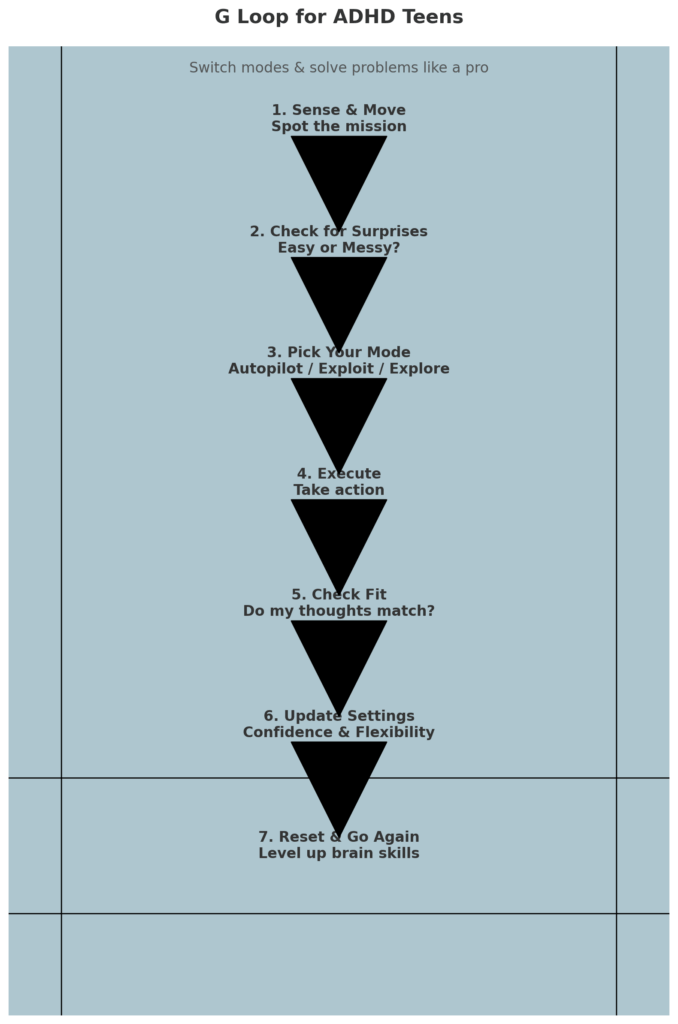
The G Loop: Your Brain’s 7-Step Game Level
Your brain runs this loop over and over, kind of like levels in a game.
Here’s how it works — and how it can help you in real life:
1. Sense & Move — Spot the Mission
First, you figure out what’s going on and what your “mission” is.
-
School example: You remember you’ve got a science presentation tomorrow. You think about the topic, time limit, and what went wrong last time.
-
Life example: Your friends are planning something after school, and you figure out if you can join without skipping homework.
🧠 ADHD tip: Write your “mission” down in one sentence. Your brain likes clear goals.
2. Check for Surprises — Is This Easy or Messy?
Ask: “Is everything going fine, or is something unexpected happening?”
-
If it’s smooth, you’re in “routine mode.”
-
If it’s messy, you need to change your plan.
Example: You’re ready for your presentation but the teacher says, “We don’t have the projector today.” Uh-oh — now you’ve got to think fast.
🧠 ADHD tip: If things go sideways, don’t panic — say “plot twist!” and move to step 3.
3. Pick Your Mode — 3 Ways to Play
Your brain has three main “modes,” like different controllers:
-
Autopilot – Stick to what you’ve practiced.
-
Example: Shooting free throws exactly how you always do.
-
-
Exploit (Capitalize) – Something’s working better than usual — do more of it.
-
Example: People laugh at your first joke in your presentation — so you add more humor.
-
-
Explore (Experiment) – Things are going wrong — try something new.
-
Example: No projector? You grab the whiteboard and draw diagrams instead.
-
4. Execute — Take Action
Once you’ve picked your mode, do it.
-
Use tools: diagrams, quick notes, or simple checklists.
-
ADHD hack: Get out of your head — make your ideas visible so you don’t lose them.
5. Check If It Fits — The “Do My Thoughts Match?” Test
Sometimes your brain feels like a group chat where everyone’s talking over each other.
-
If everything lines up, lock in your decision.
-
If it’s a mess, get more info or ask for advice before deciding.
6. Update Your Brain Settings
Your brain has two “dials” that change every time you loop:
-
Confidence (η) – How sure you feel you can pull it off.
-
High = “I’ve got this, let’s roll!”
-
Low = “Not sure… let’s try different stuff until I’m sure.”
-
-
Uncertainty (χ) – How much your brain disagrees with itself.
-
High = You stop and think more before acting.
-
Low = You act quickly.
-
🧠 ADHD tip: If you win, turn your “confidence dial” up. If you fail but learn something, turn your “flexibility dial” up.
7. Reset & Run the Loop Again
Once you finish, your brain resets and gets ready for the next challenge.
Every time you run the loop, you’re leveling up — your brain gets better at switching between autopilot, capitalizing, and experimenting.
Why This Matters for ADHD
-
ADHD brains can hyperfocus in Autopilot mode but also get stuck there. The G Loop helps you notice when it’s time to switch.
-
Your confidence and uncertainty dials explain why some days you feel unstoppable and other days you can’t decide on lunch.
-
Using the loop on purpose can help you turn “chaos brain” into a flexible problem-solving brain.